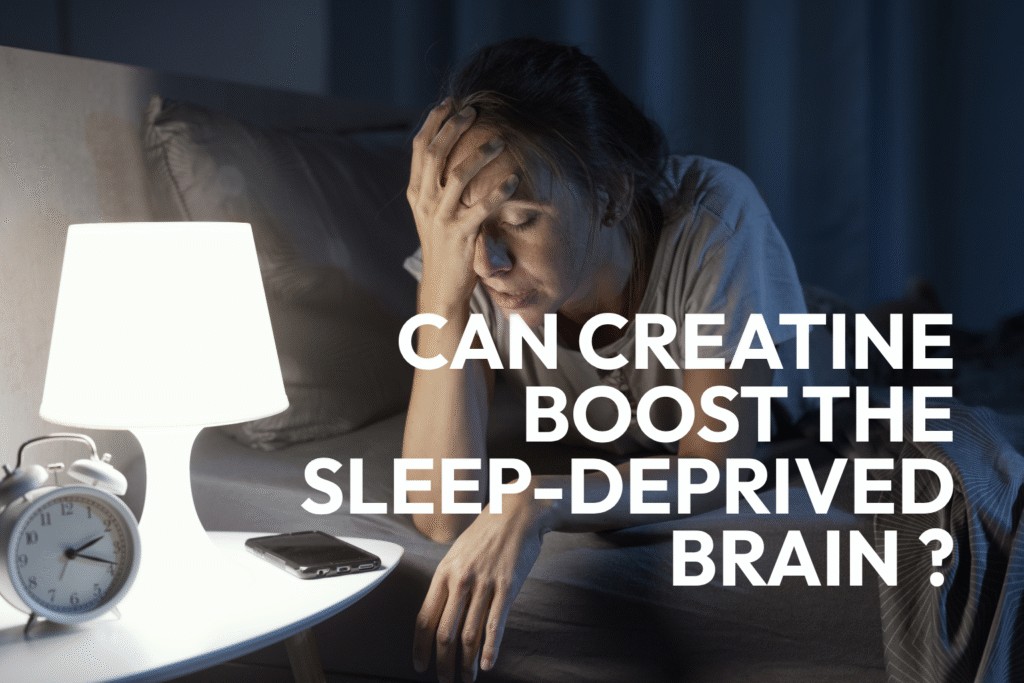
The alarm rings after a shorter night than you planned. Your calendar has not become any lighter. It is easy to understand why a headline about creatine and the sleep-deprived brain gets attention.
The science is interesting in its own right. Rather than asking whether a product makes someone “feel sharper”, one research team examined cognitive performance alongside changes related to the brain’s energy system.
Why look at creatine during sleep loss?
Creatine is involved in cellular energy buffering. Sleep deprivation gives researchers a demanding condition in which to investigate its effects on the brain and performance. A 2024 paper in Scientific Reports brought these questions together in a controlled experiment. [1]
For the reader, the useful starting point is the setting: this was a study of sleep-deprived participants, not an ordinary morning after a full night’s rest.
What the experiment found
The researchers used a single high dose of creatine, 0.35 g per kilogram of body weight, and assessed participants over the following hours during sleep deprivation. They reported improvements in selected cognitive-performance measures and changes in cerebral high-energy phosphates. [1]
That makes the paper a compelling example of researchers connecting a biological mechanism with a measured outcome. It does not establish that an ordinary daily serving gives everyone an immediate focus boost. The experimental dose is not a self-use recommendation. [1]
An interesting finding, with a useful distinction
Imagine comparing two headlines: one names a specific test under sleep deprivation; the other promises to make every demanding day effortless. Only the first tells you what was investigated.
You can be interested in the result without turning it into a rule for your own day. The research opens questions about brain energy. Your daily routine still needs to fit the way you live and the instructions on the product you use.
Give a demanding day a clearer shape
If the topic feels familiar, start with a practical planning question: what genuinely needs your attention today, and what can wait? That question is useful whether or not you take a supplement.
- Choose the priority. Write down the task you most need to complete.
- Reduce the setup. Put what you need together before you begin.
- Protect the next opportunity to rest. Avoid treating a research headline as permission to keep shortening the night.
These are simple organisational suggestions, not a treatment for fatigue. Ongoing sleep difficulties or unusual tiredness deserve individual advice.
Keep exploring the energy story
For the broader context, read Your brain needs energy, too. For the mechanism behind it, our ATP and cellular-energy explainer makes the chemistry easier to follow.
Considering creatine for a consistent training routine? Explore QLEOS Optimized Creatine, check the labelled serving and choose it around a clear goal. Interesting research should help you make a more informed choice.
Sources & further reading
- Single dose creatine improves cognitive performance and induces changes in cerebral high energy phosphates during sleep deprivation. Gordji-Nejad et al. Scientific Reports, 2024. doi:10.1038/s41598-024-54249-9.
From the QLEOS Journal. We make supplements and explain the research behind the conversation. The studies cited here did not test the finished QLEOS product. This is general information, not personalised medical advice.