

Testing
Results
Independent Laboratory Analysis
Certified testing performed by Mérieux NutriSciences / CHELAB S.r.l. (ACCREDIA 00051)
Sample: QLEOS Biotech — Optimized Creatine • LOT BI04202615
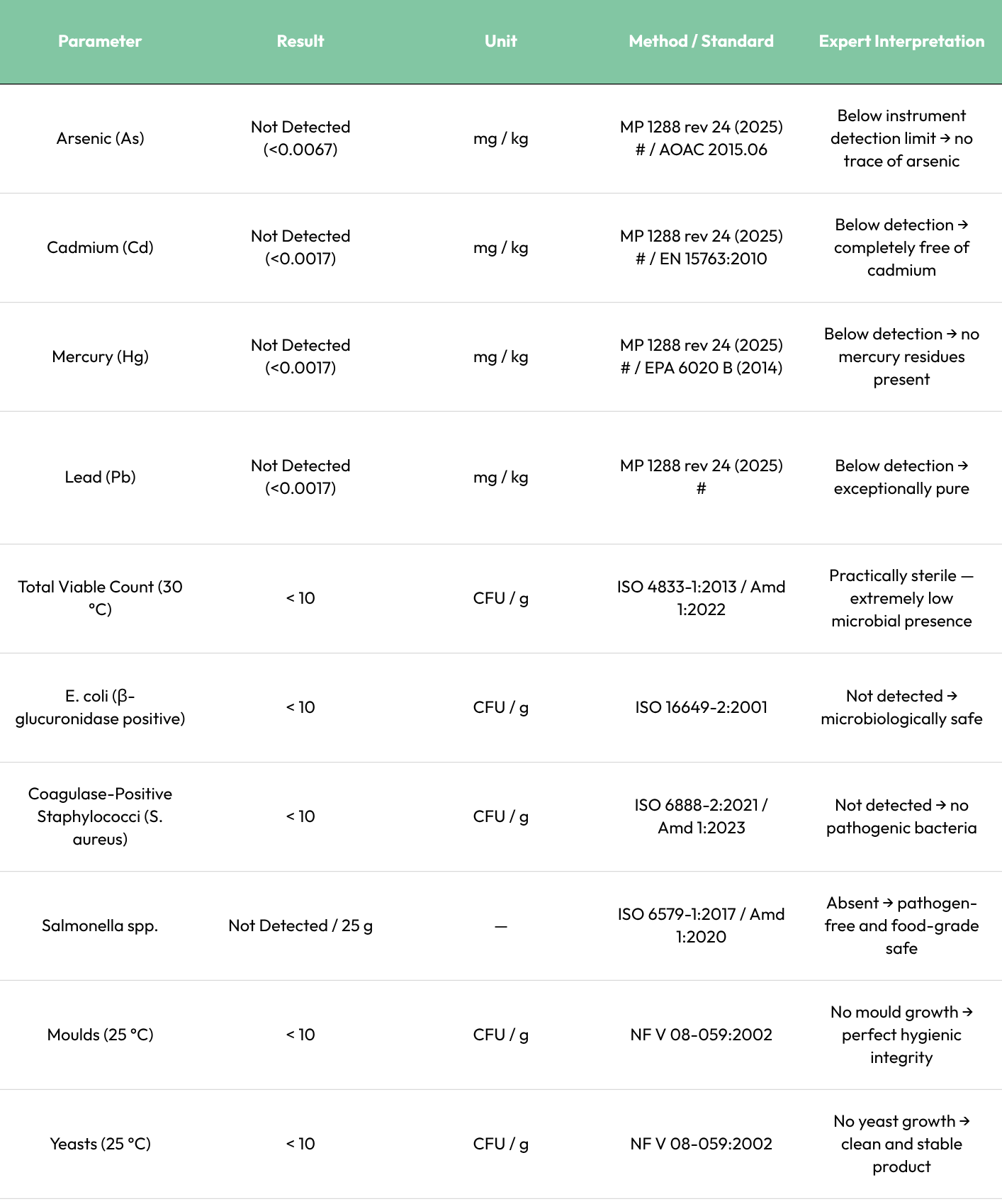
Laboratory report: Lab Summary Mod. 716/SQ rev. 14 — Acceptance No. 26.242331.0008
Analyses performed at Mérieux NutriSciences Resana, under ACCREDIA accreditation n. 00051.
Testing performed by Eurofins Technology Service Co., Ltd.
Using validated analytical methods to verify creatine monohydrate content, moisture, typical synthesis residues and degradation markers.
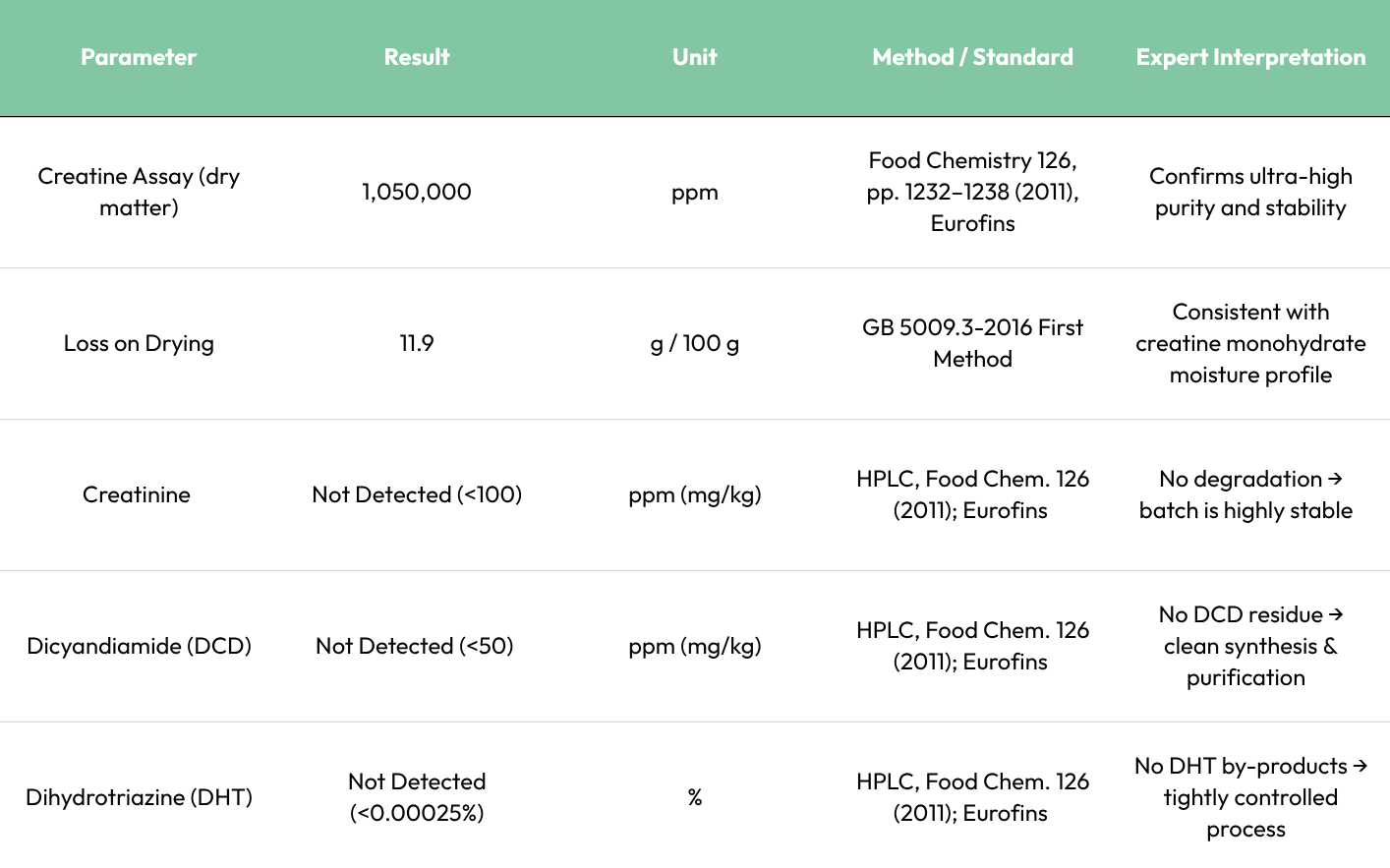
The confirmed creatine monohydrate content, controlled moisture profile, absence of quantifiable creatinine and dicyandiamide (DCD), together with non-detected dihydrotriazine (DHT), further supports the high-grade purity and controlled manufacturing process of Optimized Creatine.
Scientific Assessment
All toxic metals (As, Cd, Hg and Pb) were not detected, i.e. below the laboratory’s limit of detection.
Lead (Pb) was not detected at the method detection limit (<0.0017 mg/kg), placing the result more than 1,700 times below the EU maximum limit of 3 mg/kg for food supplements.
Eurofins testing confirmed creatine monohydrate content at 1,050,000 ppm and moisture at 11.9 g/100 g, consistent with a stable creatine monohydrate profile.
Residual compounds — creatinine, dicyandiamide (DCD) and dihydrotriazine (DHT) — were verified using validated methods. Creatinine and DCD were below the limit of quantification, while DHT was not detected at the method detection limit, supporting a clean and controlled production process.
No detectable microbial growth of concern — total viable count below 10 CFU/g, with tested pathogenic species absent. Verified according to ISO, EN, EPA and AOAC-based methods under ACCREDIA accreditation n. 00051.
Overall, Optimized Creatine LOT BI04202615 shows a high-purity analytical profile, with no tested contaminants detected above analytical limits and excellent microbiological safety.
Analytical Methods & Standards
Heavy metals (Pb, As, Cd, Hg) — Internal method MP 1288 rev 24 (2025), based on AOAC 2015.06, EN 15763:2010, EPA 6020 B (2014).
Total Viable Count (30 °C) — ISO 4833-1:2013 / Amd 1:2022.
E. coli (β-glucuronidase positive) — ISO 16649-2:2001.
Coagulase-positive Staphylococci (S. aureus and other species) — ISO 6888-2:2021 / Amd 1:2023.
Salmonella spp. (qualitative) — ISO 6579-1:2017 / Amd 1:2020, with confirmation by MALDI-TOF where applicable.
Yeasts & Moulds (25 °C) — NF V 08-059:2002.
Creatine Monohydrate, Creatinine and Dicyandiamide (DCD) — HPLC method based on Food Chemistry 126 (2011) 1232–1238.
Moisture — GB 5009.3-2016 First Method.
Dihydrotriazine (DHT) — USP Creatine Monograph Mod.
Regulatory & Quality Framework
Production of QLEOS products are manufactured exclusively in EU-certified facilities, operating under comprehensive regulatory systems aligned with international manufacturing and safety standards. These certifications are held by the contract manufacturer and reflect the controlled environment and traceable supply chain that ensure the integrity and reproducibility of each batch.

Implements a fully traceable, risk-based control framework that integrates supplier verification, raw material monitoring, and process hygiene to guarantee food-grade safety at every step.
Ensures continuous process validation, documentation accuracy, and adherence to standardized manufacturing procedures, resulting in exceptional batch-to-batch consistency and reliability.
Confirms that manufacturing operations are conducted with environmental responsibility, emphasizing sustainable energy use, emission control, and waste minimization.
Establishes a preventive safety protocol identifying and controlling potential contamination points throughout the production and packaging chain, ensuring complete microbiological safety.
Ensures that food supplement production is carried out under controlled hygienic conditions, with validated procedures, documented quality assurance systems and full traceability. GMP 3-2014 certification confirms that every batch is manufactured, checked and released according to internationally recognised Good Manufacturing Practice for dietary supplements.
Internal Expert Conclusion
From a scientific and regulatory standpoint, the analytical profile of Optimized Creatine LOT: BI04202615 demonstrates an exceptionally clean creatine monohydrate profile, verified against relevant European food-supplement safety parameters and QLEOS Biotech internal high-grade specifications.
The combined absence of tested toxic elements, process-related residues dicyandiamide (DCD) and dihydrotriazine (DHT), degradation markers such as creatinine, and microbiological contaminants supports the high efficiency of the purification and crystallisation process. The batch has been verified through independent testing in two laboratories — Mérieux NutriSciences / CHELAB S.r.l. (ACCREDIA n. 00051) for heavy metals and microbiology, and Eurofins Technology Service Co., Ltd. for creatine monohydrate content, moisture, DCD, DHT and creatinine — confirming a high-purity analytical profile suitable for premium nutraceutical-grade creatine manufacturing.