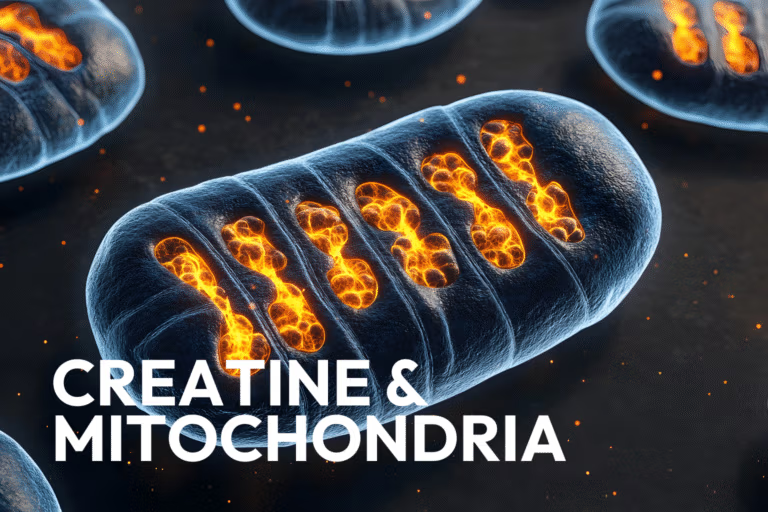
Most women have heard of creatine  but often in the wrong context. It is still too often seen as “a supplement for men,” or something only relevant for bodybuilding, bulking, or elite performance. But that picture is outdated. Newer research suggests creatine for women may matter far beyond the gym: for strength, recovery, cognition, mood, and potentially even key life stages shaped by hormonal change from the menstrual cycle to post-menopause.

What makes this especially important is that the female body is not just a smaller version of the male body. Hormonal fluctuations across the menstrual cycle, pregnancy, postpartum, and menopause can influence creatine homeostasis, creatine kinase activity, and energy regulation. In other words, creatine is not just about muscle  it is part of a wider energy system that may be uniquely relevant to women.

Why Creatine for Women Deserves More Attention

Creatine helps recycle ATP, the body’s immediate energy currency, through the creatine–phosphocreatine system. That matters most in tissues with high and changing energy demand, especially muscle and brain. The 2021 lifespan review notes that females have 70–80% lower endogenous creatine stores than males which may give them a greater capacity to increase creatine stores in response to supplementation and also tend to consume less dietary creatine, which is one reason supplementation has drawn increasing interest in women’s health research. Female physiology adds another layer. Because estrogen and progesterone influence creatine metabolism and energy regulation, the menstrual cycle may also affect creatine homeostasis. That is one reason creatine for women is now being viewed in a broader, more female-specific context.

“Creatine for women is not only a performance topic, it is a cellular energy topic.”

Creatine for Women: Exercise Performance, Strength, and Body Composition

Creatine can be especially valuable for women who want better training performance and a stronger, leaner body composition over time. By helping the body regenerate ATP more efficiently, it supports higher-quality resistance training, repeated high-intensity efforts, and better output during demanding sessions. In practice, this can mean stronger lifts, better training capacity, improved recovery between sets, and more consistent progress over time.

What makes this especially relevant for body composition is not “bulk,” but recomposition. With consistent training, creatine may help support more lean mass, a higher proportion of muscle tissue, and a firmer, more athletic look over time. Because it supports training quality and muscular performance, it can also help women create a stronger stimulus for muscle growth and body-shape changes through resistance training. It also increases intracellular water, meaning water is drawn into muscle cells, where it supports muscle function, cellular hydration, and muscle fullness. This is part of why muscles may look and feel better supported in training, not softer or puffier.

In practice, some women may notice better workout performance, improved muscle fullness, and early body-composition changes within a few weeks to around a month especially when creatine is combined with resistance training, enough protein, and consistency. Over time, this can translate into better strength, more lean tissue, improved muscle quality, and a more defined physique.

Creatine for Women and Brain Health

The brain is also a high-energy organ, and creatine plays an important role there too. The 2021 review explains that brain activity rapidly uses phosphocreatine to help maintain ATP, and that creatine supplementation has been shown to support neural ATP resynthesis. Human studies cited in the review reported improvements in cognitive performance, brain function, and reduced mental fatigue during demanding mental tasks, with some benefits appearing especially relevant during periods of sleep disruption or high cognitive load. This may be particularly meaningful for women, as the review notes that stages such as postpartum, pregnancy-related sleep loss, and menopause can place added demands on mental energy and recovery. The newer 2025 review continues this direction, highlighting cognition and mood as important areas of interest in women’s health. Taken together, the message is clear: creatine is increasingly being viewed as support for both physical and mental performance, not only gym performance.

Cellular Bioenergetics, Mood, and Mental Resilience

Another important reason this matters is cellular bioenergetics. The 2021 review notes that depression risk in females is higher than in males and can rise around major hormonal transitions such as puberty, the luteal phase, postpartum, and perimenopause. It also summarizes evidence linking brain creatine metabolism with mood regulation, suggesting that altered brain bioenergetics and mitochondrial dysfunction may be part of the picture. This does not mean creatine should be presented as a treatment for depression, but it does support a careful and credible conclusion: by helping support brain energy availability and cellular homeostasis, creatine may also support mood, cognitive resilience, and mental function in women.

“Creatine is one of the most researched and safest supplements available for women, consistently shown to support performance, recovery, energy and overall health.”

Creatine and the Female Hormonal System: What Changes Across the Cycle

To understand why creatine may be especially relevant for women, it helps to look at the body’s hormonal rhythm. Across the menstrual cycle, estrogen and progesterone rise and fall in a predictable pattern, influencing not only reproduction but also energy production, fuel use, recovery, and protein turnover. Research suggests estrogen plays an important role in bioenergetics, while the luteal phase may be associated with higher protein breakdown, lower carbohydrate storage, and shifts in creatine metabolism and creatine kinase activity.

This helps explain why the topic is now being discussed in a broader, more female-specific context. Current evidence suggests that creatine supplementation may be especially relevant during phases of the cycle when recovery, cognition, sleep, and energy regulation feel less stable, and it may help support muscle protein preservation during the luteal phaseOverall, the most balanced takeaway is that creatine should not be viewed only as a gym supplement, but as part of a wider energy-support strategy that may align in meaningful ways with female physiology.

Creatine for Women in Pregnancy and Postpartum

Pregnancy is one of the clearest examples of why creatine should be discussed as a women’s health topic, not only a sports supplement. During pregnancy, energy demand increases significantly, especially in the placenta and developing fetus and research suggests this may be associated with reduced creatine availability. Because creatine plays a key role in cellular energy production, it is being explored for its potential to support energy metabolism, mitochondrial function, and cellular resilience during this period. At the same time, it is important to understand the type of evidence available: pregnancy-specific findings currently come mainly from animal studies, while much of the evidence on exercise performance, cognition, mood, and women’s health across the lifespan comes from human research. Postpartum is another highly demanding phase, shaped by recovery, sleep disruption, and increased mental load, which is why creatine is also being explored as a potentially useful support strategy during this stage. Still, because pregnancy and breastfeeding are unique physiological states, creatine supplementation during these periods should always be discussed with a qualified doctor.

Creatine for Women in Perimenopause and Menopause

Menopause is another stage where creatine becomes especially relevant in women’s health. As estrogen declines, women often experience gradual losses in muscle mass, strength, recovery capacity, and overall musculoskeletal resilience, along with reduced metabolic flexibility and a less efficient response to training. These changes can make it harder to maintain lean tissue, preserve physical function, and feel as strong or energized as before. This is where creatine may be especially valuable. Beyond its role in performance, creatine helps regulate cellular energy by supporting rapid ATP regeneration and stabilizing energy availability in tissues with high demand, especially muscle and brain. In practical terms, this can help support training quality, lean mass, strength, physical function, and overall energy resilience. When combined with resistance training, creatine may also support musculoskeletal health more broadly, including healthy aging of muscle and bone. Overall, the strongest evidence appears to be in post-menopausal women, while perimenopause remains an important area that still needs more direct research.

What This Means in Real Life

Creatine for women is not only about lifting heavier. It is about supporting an energy system that sits underneath training, cognition, recovery, and resilience. It may help women train harder, recover better, preserve lean mass, support brain energy, and navigate hormonally demanding life stages with more cellular support in place. At the same time, the strongest evidence is still in exercise performance, strength, and post-menopausal musculoskeletal health, while pregnancy and perimenopause remain promising but less settled areas.

At QLEOS, we believe women deserve better than outdated supplement narratives.

Creatine is one of the most researched ingredients in sports nutrition and the newer female-specific literature makes it increasingly clear that its potential reaches beyond performance alone. Our ultra-pure, ultra-fine creatine is designed to mix easily, feel smooth, and fit into a consistent daily routine because the real value of creatine is not in one dramatic workout, but in long-term support for strength, recovery, brain energy, and resilience.

Because when energy works better, everything built on top of it works better too.

Study Reference

Smith-Ryan, A. E., Cabre, H. E., Eckerson, J. M., et al. (2021). Creatine Supplementation in Women’s Health: A Lifespan Perspective. Nutrients, 13(3), 877. PMC7998865. [link]

Smith-Ryan, A. E., DelBiondo, G. M., Brown, A. F., et al. (2025). Creatine in women’s health: bridging the gap from menstruation through pregnancy to menopause. Journal of the International Society of Sports Nutrition. PubMed 40371844. [link]

Leave a Reply

Your email address will not be published. Required fields are marked *

Science-backed tips

Join the Inner Circle
Save 10% now

+ FREE Shipping

  • Welcome Discount
  • Access to limited-time offers